Circularity
Think Circular is Castrol's first PATH360 guiding principle - find out more about what that means to us.

The circularity initiatives described on this page represent targeted actions to improve resource efficiency and reduce waste. They do not reflect the entirety of Castrol's environmental footprint or product range. Approximately 99% of Castrol's greenhouse gas emissions arise from Scope 3 emissions from across its value chain, and reducing those remains a key challenge and focus area.
What is circularity?
Today, the global economy is predominantly “linear” – we take resources from the environment, make products from them, use them and eventually dispose of them. However, a circular economy aims to keep products and materials in use for as long as possible, reducing waste, lowering demand for virgin resources and creating more resilient value chains.
Here at Castrol, we’re harnessing circular economy thinking to explore opportunities to improve the life-cycle environmental profile of our products and services. We use it to look for opportunities in both our Inputs (i.e. how we make our products, how they are transported and what happens to them after use) and our Outputs (i.e. how our products and services can help our customers). This approach extends our focus beyond the boundary of a traditional product carbon footprint. We call this approach “Think Circular” and it is one of our PATH360 guiding principles.
Within PATH360, “Think Circular” is the name of an internal guiding principle used to consider material inputs, product use, recovery and end-of-use routes. It is not a claim that a product, service or the business is fully circular.

Outputs
We develop high performance products and services that support our customers with their energy, waste and water sustainability goals and we support multiple sectors from automotive, to industry, shipping and energy production.

Inputs
Working to increase our use of renewable energy.
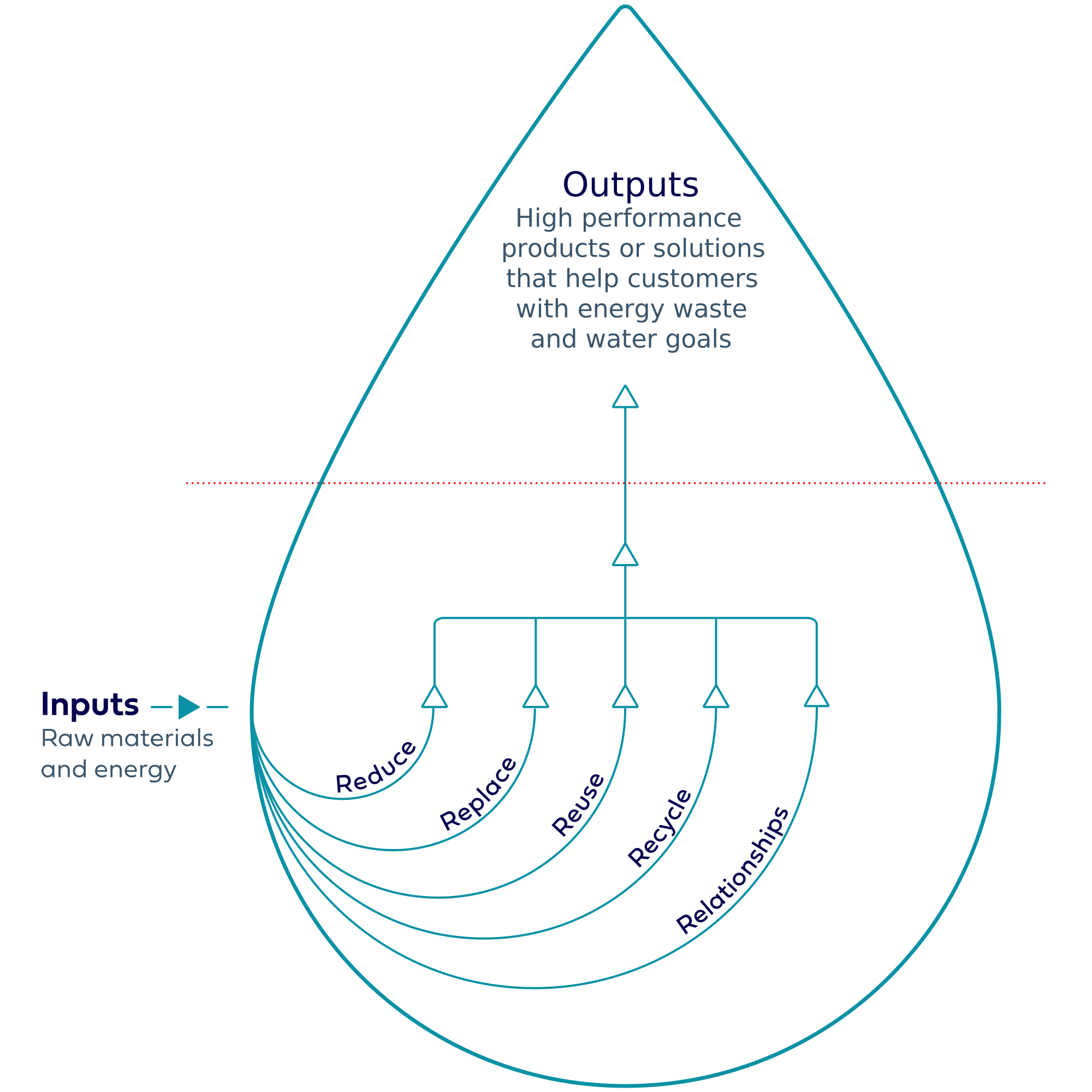

Reduce
Working to reduce raw material demand across the value chain e.g. long drain formulations that work for longer, packaging reduction programs.

Replace
Investigating alternative raw materials and techniques (e.g. alternative ingredients or digital services).

Reuse
Designing with the end in mind, considering the system as a whole and working to reduce raw material demand.

Recycle
Using recycled materials to lower product environmental profile and keep materials in use.

Relationships
Partnering, sharing, advocating and providing technical support.
Thinking circular in action
Outputs
In total, ~23% (119 EJ) of the world’s total energy consumption originates from tribological contacts. ~20% (103 EJ) to overcome friction and ~3% (16 EJ) to remanufacture worn parts and spare equipment due to wear and wear-related failures1.
Our products can help our customers save energy (by reducing friction), save waste (by extending machine life) or save water (e.g. reducing water use in metal cutting). We are focused on developing and delivering high-performance solutions to maximise this contribution for our traditional customers and by extending our expertise to support new and growing sectors like renewable energy generation and thermal cooling applications.
We have developed a methodology to identify which of our products deliver these services better than industry standard. The methodology has been assured by Ricardo Energy & Environment. In 2025, sales of products that help our customers save energy, waste or water represented 34% of Castrol’s total volume sold (vs 12% in 2019).
Inputs
Click on the tabs below to see examples of how we have applyed this Think Circular approach on some of our inputs.

Reducing blend temperatures and blending time in 5 plants across the globe.

Increasing the use of renewable electricity in place of fossil fuel derived electricity. Boiler conversion from Diesel or other fuel to natural gas in 5 plants. Implemented LED lighting.

Our plant in Neuhoff purchases steam generated through energy recovery from waste incineration at a neighbouring facility.
Result
In 2025 scope 1 and 2 emissions were 55% lower than in 2019. N.B. Scope 1& 2 emissions represent ~ 1% of Castrol’s total emissions. The rest are Scope 3.
Replacing conventional base oils with re-refined base oils.
Result
In 2025 5.5% re-refined base oil (vs 0.1% in 2019)

Offers for commercial customers in US and Turkey, to divert used oil towards re-refining.

Partnering along the supply chain to offer collection and recycling.
Result
>4ml used oil sent to re-refining in 2025 (vs 0mL in 2019)
New bottle designs with less plastic per litre sold.
Offering customers bulk delivery (where practical) instead of packed products.
Increased use of PCR (post-consumer recycled) plastic in bottles.
Reusable IBC and container systems.
Working with suppliers on pack design and sourcing recycled material.
Result
-18% plastic footprint in 2025 vs 2019
Measuring circularity with CTI
To assess product-level material Circularity Castrol has adopted the World Business Council for Sustainable Development’s (WBCSD) Circular Transition Indicators (CTI) framework. In 2025, Castrol applied CTI to a sample of 13 products in the US and Australia and had the resulting circularity scores independently verified2. This proof-of-concept work showed the average CTI scores improved from 7% before the circular interventions to 53% after. These assessments focused on what the CTI framework calls % Material Circularity, which looks at both circular inflow, such as the use of non-virgin or renewable materials, and circular outflow, such as the recovery and re-refining of used oil.
| What CTI helps us measure | Why it matters for Castrol |
|---|---|
| Circular inflow: the proportion of product materials that are non-virgin or renewable. | Supports clearer measurement of actions such as using re-refined base oils or other lower virgin-material inputs. |
| Circular outflow: the proportion of used product that is recovered and directed into a circular route, such as re-refining. | Helps reflect the importance of collection, recovery and value-chain partnerships, which are central to building more circular systems. |
| % Material Circularity: the average of circular inflow and circular outflow within the CTI methodology. | Provides a complementary metric to product carbon footprints, helping describe material circularity without replacing greenhouse gas accounting. |
Relationships in action in motorsport
Moving towards a more circular model requires action across the value chain. As an example we are proud of our work with our race partners who are helping us showcase how fluids formulated and managed in a more circular way can perform even under extreme conditions.
Castrol MEM Rally Team
This year, the Castrol MEM Rally Team powered to victory in the British Rally Championship.
Castrol MEM Rally Team
The Castrol MEM Toyota Rally Team Yaris Rally2 cars competed in the 2024 British Rally Championship with lubricants formulated with material re-refined from used oils. This demonstrated the formula performing under the intense pressures of a rally competition.
Jaguar TCS Racing
Reliving those golden moments en route to becoming Season 10 ABB FIA Formula E World Champions!
Jaguar TCS Racing
Together Jaguar TCS Racing and Castrol have collaborated through extensive technical research both on and off track to develop more circular transmission fluids. During season 10 (2023/24) used transmission fluid was collected from the I-TYPE 6, then re-refined to recover its main constituent base oil. This re-refined base oil was then blended with performance additives to make fresh EV transmission fluid to run in the Jaguar I-TYPE 6 gearbox. Congratulations Jaguar TCS Racing for being crowned Season 10 Champions.
Castrol is immensely proud to work alongside the winning team.
RFK Racing
Designed to Perform with RFK Racing
RFK Racing
Since 2022, RFK Racing has been using - and winning with – Castrol products formulated with re-refined base oil. With an unforgettable win at Darlington earlier 2024, we look forward to building on our continued collaboration with RFK Racing.
Castrol in action – Castrol MoreCircularTM
Castrol MoreCircular is our programme to keep resources in use for longer. Through products made with re-refined base oils, packaging designed to use less virgin plastic, and collection services that keep materials in use for longer, we’re building circularity into the way we do business.
Our vision is a more circular lubricants ecosystem where used oil is collected, re-refined and formulated back into Castrol products.
