PATH360 Castrol Product Sustainability Assessment (CPSA) (4th Edition)
Our requirements for Castrol products and services to be included as part of the PATH360 family.

This document describes our assessment criteria for products and services to qualify to be included in the PATH360 family. We developed these criteria to help focus on the contributions Castrol can make to a more efficient future and to help us to assess our sustainability progress. This fourth edition incorporates the recommendations made as part of an independent review conducted by Ricardo Energy & Environment in 2026.
The product assessment criteria in this document will be kept under review and revised when Castrol considers it necessary due to changing circumstances and at least every two years.
Published April 2026
Quick Links
Use the links below to jump down to the relevant section of the page.
IMPROVING THE ENVIRONMENTAL PROFILE OF OUR OFFERS
Using the criteria included in this Castrol Product Sustainability Assessment, independently assured by Ricardo Energy and Environment, we can rank our products and highlight opportunities for improvement.
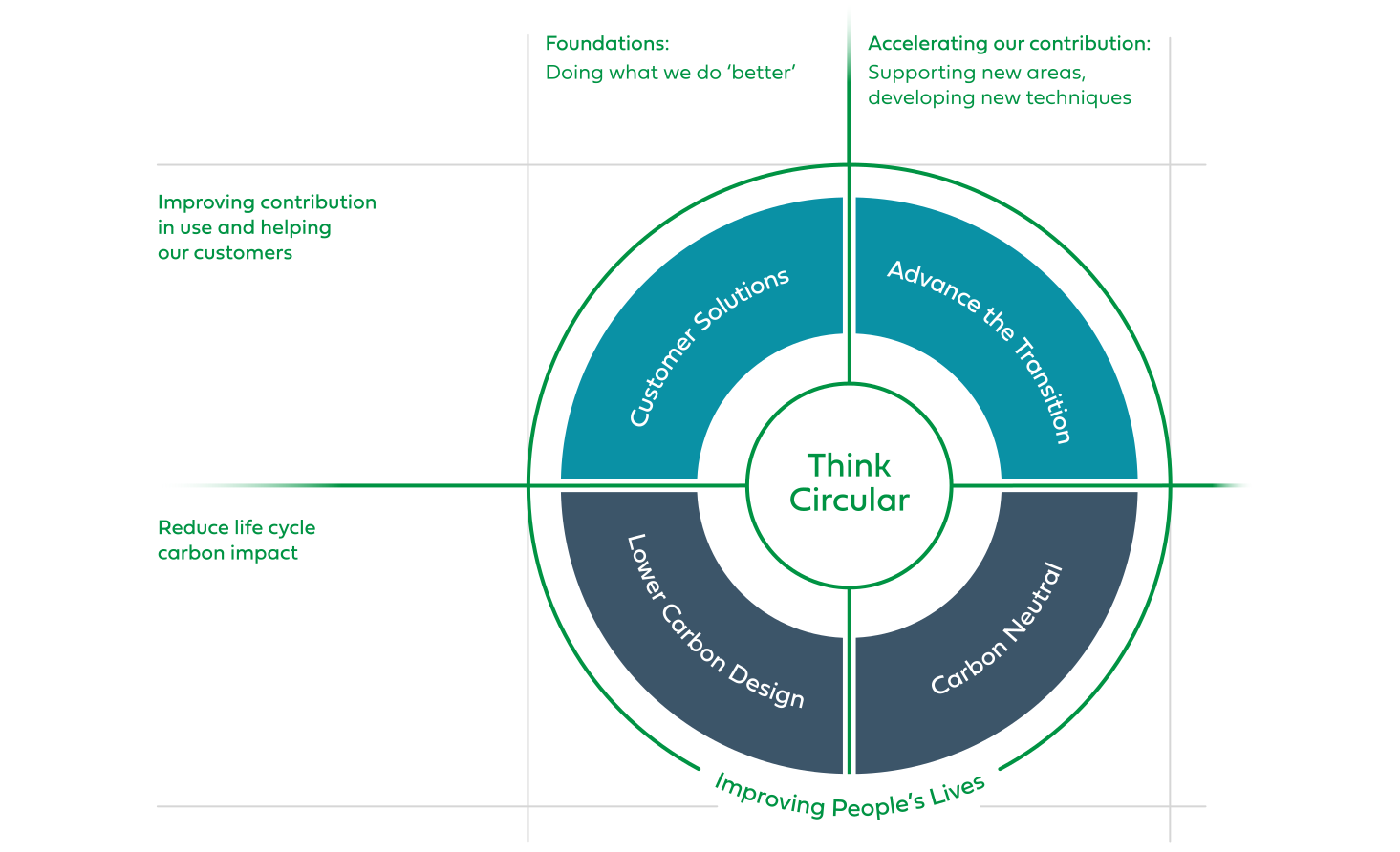
There are currently four categories of assessment criteria which mirror our PATH360 guiding principles. A product or service can qualify to be part of the PATH360 family if it meets the qualifying criteria under one (or more) of the categories.
They are:
- Customer solutions
- Supporting the transition
- Lower carbon design
- Compensation
| CATEGORY | SUB-CATEGORY | SIMPLIFIED QUALIFYING CRITERIA | Tier 1 |
|---|---|---|---|
| Customer Solutions | Energy | PATH360 | Improves Fuel Efficiency | 1 |
| Waste | PATH360 | Longer Life, Less Waste | 1 | |
| PATH360 | Reduces Waste | 1 | ||
| PATH360 | Recycled Content | 1 | ||
| Circularity | PATH360 | Recycled or Renewable Content (Product) | 1 | |
| PATH360 | Used Oil Collection (Customer) | 1 | ||
| PATH360 | Recycled / Renewable Content + Used Oil Collection (Prod + Customer) | 1 | ||
| Water | PATH360 | Water Saver | 1 | |
| PATH360 | Water Quality | 1 | ||
| PATH360 | Health & Environment | 1 | ||
| Health & Environment | |||
| Data Centre Cooling Fluids | PATH360 | Data Centre Cooling Fluids | 1 | |
| Supporting the Transition | Supporting the adoption of e-mobility solutions | PATH360 | E-Mobility | 2 |
| Supporting the generation of renewable power | PATH360 | Supporting the Transition | 2 | |
| Supporting the maritime industry transition | PATH360 | Supporting the Transition | 2 | |
| Lower Carbon Design | Lower Carbon Design | PATH360 | Lower Carbon Design | 1 |
| Compensation | Carbon Compensation | PATH360 | Carbon Compensation | 2 |
| Credit backed offers | PATH360 | Carbon Compensation offers | 2 |
Castrol has mapped its product portfolio against these assessment criteria to understand which products qualify and to track how they perform as a proportion of Castrol´s total sales.
The categories and associated assessment criteria are also used as part of Castrol’s new product development process to guide thinking and to help us track our investment in this space.
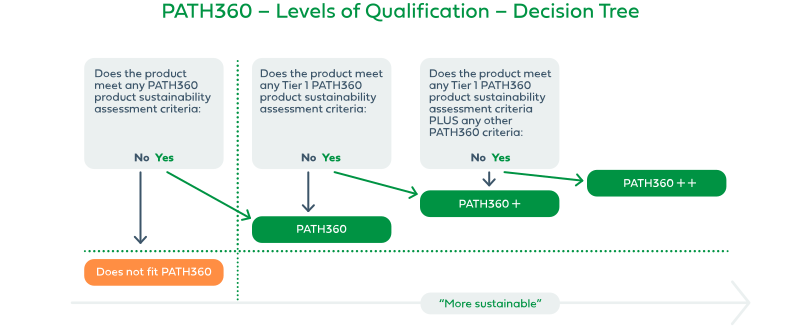
We have introduced a categorisation, tiering process and decision tree to rank Castrol products within 4 levels of qualification to aid our understanding of our portfolio as part of our improvement programme.
Tier 1 refers to products and services delivering direct, inherent, and quantifiable sustainability benefits, such as reduced carbon intensity, circular feedstock integration, waste reduction, water saving, or explicit performance improvements that materially reduce customer emissions or toxicology impacts.
Tier 2 refers to products and services that support the world’s transition to renewable energy and sustainable technologies, replacing fossil fuels with clean energy, improving efficiency, and electrifying infrastructure or the practices of compensating for impact that cannot be reduced, through the purchase of credits.
The criteria in this document will be kept under review and revised every two years or sooner, if considered necessary due to changing circumstances.
Castrol’s governance process for reviewing the qualifying criteria, includes technical experts from across the business reviewing the proposed basis for any new/updated criteria and making recommendations for endorsement by Castrol’s leadership team.
Since 2022, Ricardo Energy & Environment has performed independent review of our approach and proposed criteria and we work to incorporate their recommendations into each update.
Our Assesment Criteria
Customer solutions - products and services
To achieve the Paris climate goals1, the world will need improvements in end use energy efficiency. In one estimate, these improvements can provide almost 40% of the necessary GHG reductions.
Our products can help our customers save energy, waste or water and we are focused on high performance solutions to maximise this contribution.
Energy efficiency is critical to achieving the Paris climate goals
In total, ~23% (119 EJ) of the world’s total energy consumption originates from tribological contacts. ~20% (103 EJ) to overcome friction and ~3% (16 EJ) to remanufacture worn parts and spare equipment due to wear and wear-related failures2.
1 Energy efficiency includes enhanced technology performance as well as shifts in end-use sectors from more energy-intensive to less energy-intensive products (including through fuel shifts) Energy Technology Perspectives 2020 (windows.net) pg73.
2 Influence of tribology on global energy consumption, costs and emissions Kenneth Holmberg & Ali Erdemir 2017
Customer Solutions
Castrol products and services can contribute to their user’s energy reduction aims by reducing friction or through cooling and reducing waste by protecting from corrosion and wear. Increasingly, we are also developing offers to support commercial customers towards their water saving and protection goals.
The products and services included in the PATH360 family under the “Customer solutions” criteria are those that we consider can deliver better outcomes than industry benchmarks and thereby contribute towards their user’s objectives.
Energy
Automotive - fuel economy
Latest OEM or industry specification
Castrol’s automotive lubricants portfolio covers cars, bikes, and trucks; and within each application, the performance range offered is wide enough to cover the needs of our customers around the world, from older industry specifications to newer higher performing products carrying the latest original equipment manufacturer (OEM) and industry specifications1.
To qualify as a PATH360 product for fuel economy, a product must carry what Castrol considers to be a leading fuel economy requirement in its specification. This means the product has had to pass a stringent fuel efficiency performance requirement set either by an OEM or an industry body. Only those products where the fuel economy requirement is deemed premium/top tier are included.
Lower viscosity grades compared to market averages
A second aspect of fuel efficiency is the viscosity of the products. Lower viscosity products, regardless of the specification that they carry, can have an inherent fuel efficiency benefit vs higher viscosity grades. These lower viscosity grades are often specified by the vehicle manufactures to help meet vehicle efficiency and emissions performance requirements. This is typically led through engine design to meet these requirements which need a thinner (lower viscosity) oil to operate correctly for performance and durability in all required conditions.
Castrol considers lower viscosity grades to be any product with thinner viscosity than industry average benchmark by business segment (Cars, Trucks and Bikes).
Products which have a viscosity grade equal to or lower than 0W-20 for cars, multigrade products with viscosities equal or lower than 10W-30 for trucks and multigrade products with viscosities equal or lower than 5W-40 for bikes can qualify as PATH360 regardless of the specification the product holds.
These products are used to enable fuel efficiency benefits by cars, trucks and bikes manufacturers and are leading the lower viscosity transition around the globe.
We estimate that in 2025, Castrol´s lubricants saved our passenger car customers 247 million litres of fuel, compared to what would have been used by the same vehicles using a global industry average portfolio of lubricants2.
“Reducing the fuel consumption through lowering the engine oil viscosity by only 1% would yield calculated savings of 1.7 million tonnes of CO2-emissions based on the total 170 million tonnes of CO2-emissions generated by German road traffic annually3.”
1 these are continually updated by the industry and OEM’s and Castrol will assess these in line with the review of this document
2 due to the Castrol passenger car portfolio sold in 2025 being made up of a larger proportion of lower viscosity lubricants based on a set of assumptions. Fuel efficiency determined via the Industry M111FE test
3 Tribology in Germany: Interdisciplinary technology for the reduction of CO2-emissions and the conservation of resources 2019
Waste
Many Castrol customers have set stretching waste targets such as minimising waste to landfill, responsible use of resources and packaging targets linked to waste.
To qualify as PATH360 under the WASTE category products and services must demonstrably help their users reduce waste arisings or support their recycled content targets:
For example by:
- extending the useful life of machines
- reducing the waste generated by our product and packaging at end of use
- increasing the use of recycled content in product or packaging, .
Reduce
Extended Drain Intervals
Extended drain formulations are designed to prolong the products useful life and thereby help reduce waste.
To qualify as a PATH360 under the waste criteria “Longer Life, Less Waste”, a product will need to meet an extended drain interval specification. This means the product has had to pass a stringent extended performance test or an in-field assessment above and beyond what is typical for that application.
For example,
CASTROL VECTON | CASTROL UK & IRELAND Fully synthetic (SAE 10W-40) and part synthetic (SAE 10W-30) diesel engine oils which have been tested for extended drains up to 120,000 km1.
CASTROL CRB PLUS | CASTROL INDIA Further field trial work has been conducted to prove the 15W-40 for on-road, off-road and agricultural applications ensure optimum engine performance in demanding operating conditions for extended drain intervals up to 1000hours2 (increased from previous 600hours).
CASTROL DURATEC NG & ES | CASTROL USA They exceed natural‑gas engine oil standards by maximizing uptime, extending drain intervals, and delivering strong engine protection. Duratec NG delivers 100 hours beyond the industry’s 500‑hour standard, while Duratec ES extends performance by an additional 700 hours, vs the 500hour industry standard3.
1Approved by MAN for up to 120,000 km and Mercedes Benz, Volvo, and Renault for up to 100,000 km in accordance with their specifications. Actual oil drain depends on engine type, operating conditions, service history, OBD and fuel quality. Always consult your manufacturer’s handbook
2Please refer to the operator manual for recommended drain intervals for you specific equipment. Actual oil drain depends on engine type, operating conditions and service history etc. Data is based on in-field tractor testing in India.
3To demonstrate Castrol Duratec NG & Duratec ES extended drain intervals, we conducted a 12-month test in a refuse fleet.
Extending useful life
Corrosion and wear can reduce machine life. Globally ~16EJ of energy is used to remanufacture worn parts and spare equipment due to wear and wear related failures1.
Products qualify as PATH360 in the “extending useful life” category if they can demonstrate that they have superior protection characteristics when compared to the industry standard. Products and services designed to prolong the useful life of the product thereby reducing customer waste arisings. E.g. additive boost packs that replenish additives and thereby extend oil life, or systems that clean oil to allow longer usage cycles.
Castrol Optigear Synthetic X 320 is a premium synthetic oil for wind turbine gears operating in wide temperature ranges and under high loads.
Suited for high-capacity wind turbine gears, it delivers best-in-class surface protection and reduces gear friction.
- Unique Microflux-Trans Plastic Deformation (MFT-PD) technology is proven to give up to 30% less friction1 compared to other available gear oils[] reduces critical gearbox stress, operating temperatures and wear2
- Significantly reduce further damage in pre-micropitted gears3
1The SRV friction (5ae) Test, 2016/2017
2Sincro Mecánica Wind Oil Evaluation 2016
3FZEG Micropitting test 2010
For more information visit Case Studies | Industrial | CASTROL UK & IRELAND
Reuse
By understanding the quality of residual material at end of use and the environment it is working in, we can find ways that materials can be re-used thereby reducing total waste arisings and raw material demand.
Products designed to work as systems thereby reducing customer waste arisings. When sold together these products can qualify as PATH360 in the waste category.
e.g. our Techniclean XBC product range sold as compatible cleaner to our XBB coolants is to be considered as a system enabling waste reduction.Through our partnership approach and advanced metalworking fluids offer, Renault saved 1 million litres of water and 1 million litres of waste in their automotive engine plant2.
1Influence of tribology on global energy consumption, costs and emissions Kenneth Holmberg & Ali Erdemir
2For more information visit Case Studies | Industrial | CASTROL UK & IRELAND
Circularity
Many of Castrol’s customers have aims focused at increasing the use of recycled content in place of virgin raw materials. Castrol is exploring opportunities to replace virgin raw materials in both its products and packaging.
% Material Circularity (Circularity Score)
The circularity score provides a structured measure of how effectively a product supports a more circular economy. In line with the Circular Transition Indicators (CTI) framework, Castrol assesses % material circularity by quantifying the proportion of materials that are cycled back into the value chain, either through re-refined content in the product itself and / or the proportion of used oil sent for re-refining, thereby reducing reliance on virgin materials and contributing to a more circular economy.
This evaluation includes the origin of materials (renewable, nonrenewable, recycled), their fate after use (recovered, re-refined, downcycled, or disposed), and the efficiency of the overall system in retaining material value. The treatment of secondary processes is addressed in the re-refining efficiency where material losses, contaminants and by-products are not included in the circular outflow.
By integrating CTI principles, the score provides clear, comparable insights into how well a product minimizes waste and preserves resources throughout its lifecycle. This metric supports informed decision making by highlighting opportunities for design enhancements, improved material choices, and stronger recovery systems; ultimately contributing to Castrol’s broader ambition to reduce waste, embrace circular thinking, and drive more sustainable resource use across its portfolio.
Castrol uses a mix of primary and secondary data to calculate Circularity scores.
- Primary data includes verified internal information such as product formulations, sales volumes, material classifications, and data from Castrol’s own circularity partners and research markets.
- Secondary data is used where primary data is unavailable and is sourced from trusted industry reports for collection rates, disposal routes, recovery pathways, and loss‑in‑use assumptions.
- Potential recovery combines primary insights with established industry benchmarks to ensure consistent estimation across markets.
Castrol has obtained independent assurance from DNV Business Assurance Services UK LTD regarding its use of the CTI Framework to measure % material circularity for a selected portfolio of products and regions.
Calculation Details
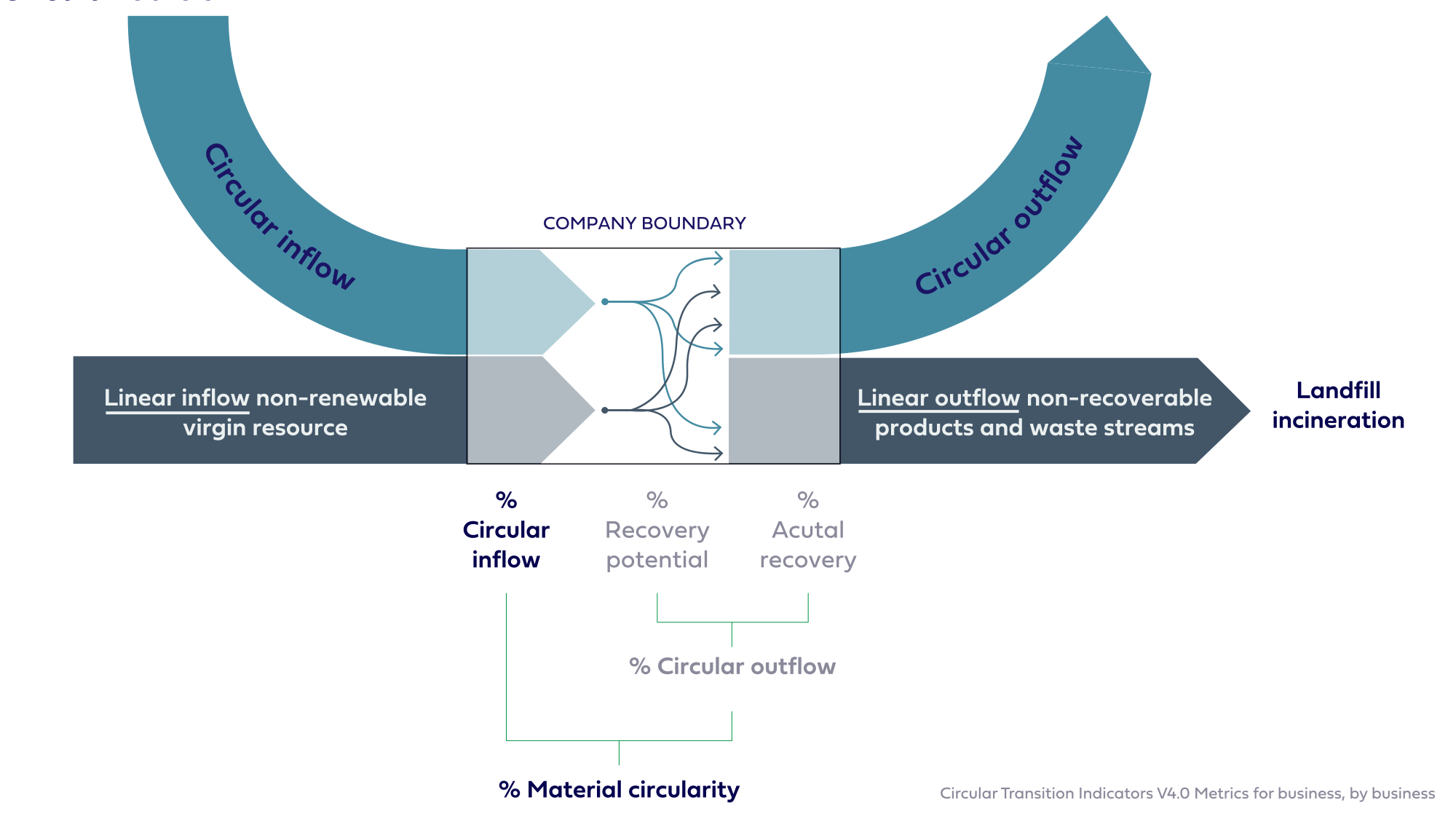
The % material circularity metric measures a product's level of circularity by computing the average of two distinct components:
- Circular inflow: How much non‑virgin or renewable material goes into a product
- Circular outflow: How much product is recovered vs potential recovery
Figure 2: Illustration of material flows
PATH360 | Recycled or Renewable Content (Product)
PATH360 | Used Oil Collection (Customer)
PATH360 | Recycled / Renewable Content + Used Oil Collection (Prod + Customer)
All products and services meeting the following criteria qualify as part of the PATH360 family in the “circularity” category,
| Qualifying Criteria | |
| Circular Inflow % | >25% |
| Circular Outflow % | >20% |
| % material circularity | >22.5% |
Definitions
- Circular inflow is the % of non-virgin or renewable content.
- Circular outflow is how much product is recovered (actual recovery) vs potential recovery.
- Potential recovery is the amount (%) of used oil generated (i.e., that is not lost in use).
- Actual recovery is equal to the % of used oil collected multiplied by the re-refining efficiency.
- The % of used oil collected is a ratio of used oil collected against total purchases of the products in scope over the same period by customers participating in Castrol’s MoreCircular program.
- Refining efficiency is the proportion of re-refined base oil generated compared to the volume of used oil input.
- % material circularity is the weighted average of the % circular inflow and % circular outflow for a given product.
- The material feedstocks which contribute to Castrol’s circular content % qualification are Re‑Refined Base Oils (RRBO) and Renewable raw materials,
- Re-Refined Base Oil is a base oil made from used oil sources that goes through an extensive process to clean and refine the feedstock into high quality base oils, ready to be used in engine oils and other applications.
- Renewable raw materials where biogenic uptake is reported in their product carbon footprint data. Castrol’s renewable inflows are mainly attributed to synthetic esters and canola oil.
- Packaging circularity is recognized as a material future pathway but is excluded from Castrol´s PSA 4th edition scoring, pending global harmonization of packaging recyclability definitions.
Water
Water is a precious resource and a valuable commodity. According to the UN, water scarcity affects more than 40% of the world’s population and is projected to rise1. According to the IPCC “roughly half the world’s population currently experience severe water scarcity for at least some part of the year due to climatic and non-climatic drivers”.
Many of Castrol’s commercial customers are setting water targets related to consumption and to reducing contamination. Castrol is developing offers and solutions to help towards these goals. To qualify as PATH360 under the water category products and services must either:
- help customers save water, or
- reduce water contamination.
Water saving
By considering the environment in which products are used they can be designed to work together to help customers reduce overall water demand.
Products designed to work as systems and/or designed to be re-used within customer processes (thereby reducing customer water demand), when sold together can qualify as PATH360 in the water category.
Reducing impact on water / aquatic environment
We help our customers meet their operational HSSE and regulatory requirements where there is potential for their discharge or accidental release to the aquatic environment, by developing products with reduced environmental profile whilst maintaining their technical performance.
This is achieved either through:
- conformance with internationally recognised “ecolabels” e.g. EU Ecolabel for lubricants or OSPAR Convention on the Protection of the Marine Environment of the Northeast Atlantic, or
- demonstrating improvement in environmental performance in comparison to an equivalent conventional mineral oil product based on biodegradation, bioaccumulation and toxicity levels.
Products meeting these criteria can qualify as part of the PATH360 family.
Techniclean XBC range reimagines the process by recycling the cleaner
Our Techniclean family of solvent and water-based cleaners enables precision cleaning of metal-worked parts in a wide range of cleaning systems. While other industrial cleaners can only be discarded, cleaners such as Techniclean XBC range can be cycled back to the coolant system without causing performance issues. This reduces waste volume, as Techniclean is constantly being reused. It also enables lower water consumption, and lower operating costs, thanks to the reduction in waste processing and clean water usage. When the cleanliness of components after process cleaning is paramount, but you also need to reduce water consumption, machining and cleaning process costs, Techniclean helps make it happen.
1For more information visit https://www.un.org/sustainabledevelopment/water-and-sanitation/
Health and environmental impact
Improving lives is one of our six guiding principles. The environmental and health profile of our products and offers is governed by legislation and/or managed through our own product risk assessments.
The toxicological and ecotoxicological properties of relevant Castrol products are assessed to determine its health and environmental impacts. The minimisation and mitigation of these impacts primarily include alternative selection of raw materials and substituting these where applicable. Where alternatives are not available measures can be taken to eliminate these raw materials or where low risk appropriate measures are put in place to manage the use of products.
Where a product can demonstrate that a raw material has been removed or substituted to mitigate the impact (ahead of legislation) it may qualify as part of the PATH360 family.
Castrol BioTac MP2 is a next generation environmentally acceptable multipurpose extreme pressure grease formulated to simplify onboard operations.
It is specially developed for a wide range of exposed marine deck applications and highly suited to medium or low-speed bearings and wire ropes. It supports compliance with US Vessel General Permit (VGP) / Vessel Incidental Discharges ACT (VIDA) legislation.
It is EU Ecolabel registered. The EU Ecolabel was established as a voluntary ecolabel award scheme intended to promote products with a reduced environmental impact during their entire life cycle and to provide consumers with accurate, non-deceptive, science-based information on the environmental impact of products. BioTAC MP2 meets the minimum requirements of EU Ecolabel by:
- >80% of certified sustainably sourced renewable content1 of the grease
- >60% post-consumer plastic content of packaging
1Tested in accordance with method ASTM D 6866.
Data centre cooling fluids
“Demand for digital services is growing rapidly. Since 2010, the number of internet users worldwide has more than doubled, while global internet traffic has expanded 25-fold. Rapid improvements in energy efficiency have, however, helped moderate growth in energy demand from data centres and data transmission networks, which each account for 1-1.5% of global electricity use.
The data centres and data transmission networks1 that underpin digitalisation accounted for around 330 Mt CO2 equivalent in 2020 (including embodied emissions), equivalent to 0.9% of energy-related GHG emissions (or 0.6% of total GHG emissions). Since 2010, emissions have grown modestly despite rapidly growing demand for digital services, thanks to energy efficiency improvements, renewable energy purchases by information and communications technology (ICT) companies and broader decarbonisation of electricity grids in many regions. However, to get on track with the NZE Scenario, emissions must halve by 2030.”
Up to 40% of data centre energy is spent on cooling, and immersion cooling can help to cut this consumption by up to 80%. Additionally, large data centres can use over 1bn L of water for cooling, and with immersion cooling this can be reduced to zero.
Immersion cooling fluids used in data centres may qualify as part of the PATH360 family under Data Centre cooling fluids.
To find out more visit: Data centre and IT cooling
Supporting the transition
Products and services that “support the transition to a more sustainable future”
Supporting the generation of renewable power from wind
We are investing in and developing products and services that support the adoption of wind power with lubricants specifically developed for wind turbines.
All products and services developed to support the generation of renewable power from wind qualify as part of the PATH360 family.
Supporting the adoption of e-mobility solutions
As part of Castrol’s strategy, we are supporting newer, growing sectors including e-mobility. electric vehicles (EVs) and hybrid vehicles play a fundamental role in the future of the automotive industry.
All products and services developed to serve e-mobility qualify as part of the PATH360 family.
Castrol has recently launched Castrol ON, a new brand for its range of advanced fluids for EVs. The range includes e-Transmission Fluids, e-thermal fluids and e-Greases. Advanced e-Transmission Fluids help extend the life of the drivetrain system and enable EVs to go further on a single charge. E- thermal fluids help keep batteries cooler, even in extreme conditions, and enable them to tolerate sustained ultra-fast charging (>150kw), while e-Greases enable EVs to perform more efficiently by minimising temperature spikes, and enhancing durability of components whilst lowering weight. Today, 2 out of 3 of the world's major car manufacturers use Castrol ON EV Fluids as part of their factory fill1.
Castrol ON:
Castrol’s e-Fluids range has been developed in close collaboration with industry partners including the Jaguar Racing Formula E Team. Castrol ON’s motorsport collaborations mean that e-Fluid technologies can be pushed and tested to the limit on the track before they reach the road.
The new Castrol on e-fluid range
e-Thermal Fluids
Castrol ON battery e-thermal fluids improve thermal management, keeping batteries cooler and at more stable temperatures, even in extreme conditions. This enables ultra-fast charging and helps to extend the life of the battery.
e-Greases
Castrol ON e-Greases play a vital role in maintaining optimum efficiency and extending the life of components.
To find out more about Castrol ON visit: castrol.com/on
1Based on LMCA data for top 20 selling OEMs (new car sales) in 2019. Used as part of OEM factory fill.
Supporting the maritime industry transition
We are investing in and developing products and services that support the world’s energy transition including in the maritime industry. Castrol consider that lubricants developed to work for Dual-Fuel, Ammonia, Hydrogen or Biodiesel/HV engines, are supporting technology innovations that support the maritime industry to transition, and can therefore be included in the PATH360 family.
Castrol also includes in this category the lubricants design to its Diesel Engines - Distillate Fuel Operation range within its Marine & Energy division, as these products are currently supporting the energy transition by enabling the adoption of cleaner than Heavy Fuel Oil (HFO) fuels in hard-to-abate sectors like shipping.
All products and services developed to serve maritime industry transition qualify as part of the PATH360 family.
Lower carbon design
Since 2014, we have been conducting product life-cycle carbon assessments for an increasing number of products within our portfolio. These assessments now cover all of Castrol’s product sales by volume. We use the Greenhouse Gas Protocol’s (“GHG Protocol)” Product Standard1 to quantify the life-cycle carbon emissions associated with a product from raw material extraction, transport, production emissions, packaging, use and fate after use.
As part of our aim to reduce the carbon intensity per litre of our products we are working to reduce the life-cycle carbon emissions of our offers by improving our operational efficiency, encouraging our supply chain to decarbonise, working to source lower carbon raw materials and working to influence in-use losses and fate after use. We want to deliver high performance products with lower life-cycle carbon footprints. We know that, as well as wanting to work with suppliers that share our values, our customers are looking for products with lower lifecycle carbon emissions (aka lower carbon footprints) to help reduce their scope 3 emissions.
“Life-cycle carbon”
To qualify for the PATH360 Family under the Lower Carbon Design category, the product must demonstrate a least a 10% lower carbon footprint (cradle-to-gate) than their predecessors. Castrol calculate the emission in accordance with the GHG Protocol’s product lifecycle accounting and reporting standard.
1Product Standard | Greenhouse Gas Protocol (ghgprotocol.org)
Compensation
Castrol products contribute to saving energy and driving efficiency in use, but there are carbon emissions associated with their life cycle. We recognise that reducing product life-cycle carbon emissions takes time and requires action all along the value chain.
In 2014, Castrol began to offer carbon compensated lubricants, verified and independently assured in accordance with (now retired) PAS 2060, BSI’s internationally recognized specification.
PAS 2060 specification required a four-stage process:
- Assessment of greenhouse gas (GHG) emissions based on accurate measurement data
- Reduction of emissions through a target-driven carbon management plan
- Offsetting of residual emissions, often by purchasing carbon credits
- Documentation and verification through qualifying explanatory statements and public disclosure
Over eleven years, the scope and geographic coverage of Castrol´s carbon compensated portfolio adapted to shifts in customer demand, peaking in 2023 when ~33% of Castrol's sales by volume were in accordance with the standard. BSI retired PAS 2060 in December 2025 and Castrol discontinued its programme. In total, Castrol bought and retired over 8 million tonnes of carbon credits to support this programme.
PAS 2060 has now been replaced by ISO14068-1:2023, which focuses on quantifying, reducing, and offsetting carbon footprints, utilizing a hierarchical approach prioritizing direct and indirect GHG emission reductions and removal enhancements within the value chain over offsetting.
Castrol will continue to monitor ISO14068-1:2023, while continuing to consider credit-backed initiatives for interested customers. However, Castrol now focuses on reducing carbon emissions primarily within the lubricant value chain and improving circularity. Please see the Disclosure section below for further information.
If re-activated, products that are independently assured in accordance with credible product carbon compensation standard such as ISO14068 could be included in the PATH360 family.
| Path360 Castrol product sustainability assessment | Example requirements | |||
|---|---|---|---|---|
| CUSTOMER SOLUTIONS | ENERGY | FUEL ECONOMY | OEM specification for fuel economy | DEXOS Gen 3 BMW LL12 FE |
| Industry specification | ACEA C2 ACEA C5 ACEA C6 | |||
| Lower viscosity vs market average | Products which have a viscosity grade equal to or lower than 0W-20 for cars, multigrades equal or lower than 10W-30 for trucks and multigrades equal or lower than 5W-40 for bikes can qualify as PATH360 regardless of the specification the product holds | |||
| Driveline Products | Transmission fluids that enhance fuel economy by reducing internal mechanical drag, friction, and heat. | |||
| WASTE | EXTEND USEFUL LIFE | To qualify as a PATH360 under the waste criteria “Longer Life, Less Waste”, a product will need to carry an extended drain interval. This means the product has had to pass a stringent extended performance test or an in-field assessment above and beyond what is typical for that application. | VW 508 00, VW 509 00 MAN 3977 (LDF- 5) Scania LDF-3 Daimler 15B 120
| |
| REDUCE | Extending useful life Protection characteristics relative to previous benchmark | Castrol trials | ||
| REUSE | Products designed to work as systems thereby reducing customer waste arisings. When sold together these products can qualify as PATH360 in the waste category. | e.g. our Techniclean XBC product range sold as compatible cleaner to our XBB coolants is to be considered as a system enabling waste reduction. | ||
| CIRCULARITY | Circularity | Product | Recycled or Renewable Content (Product) | |
| Service | Used Oil Collection (Customer) | |||
| Offer | Recycled or Renewable Content + Used Oil Collection (Prod + Customer) | |||
| WATER | SAVES WATER | Products designed to work as systems thereby reducing customer water demand. When sold together these products can qualify as PATH360 in the water category. | Castrol assessment based on field trials and field performance | |
| REDUCES IMPACT ON WATER / AQUATIC ENVIRONMENT | Conformance with internationally recognised Ecolabels or scientifically demonstrable improvement in environmental performance in comparison to an equivalent conventional mineral oil product based on biodegradation, bioaccumulation and toxicity. | Internationally recognised Ecolabel e.g. EU Ecolabel for Lubricants, Swedish Standard, Blue Angel, OSPAR Convention on the Protection of the Marine Environment of the North East Atlantic. Comparative testing for biodegradation, bioaccumulation and aquatic toxicity using internationally recognised methods e.g. Biodegradation OECD 301 series, OECD 306.Bioaccumulation OECD 117, 107 or 123 or molecular weight or diameter. Aquatic toxicity: ISO 10253, ISO 14669, PARCOM 1995, OECD 201. OECD 202, OECD 203. | ||
| HEALTH & ENVIRONMENT | Reduced toxicological or ecotoxicological impact | Products formulated to reduce or eliminate the exposure to chemicals that are harmful to human health or the environment. | Globally Harmonised System for the Classification and Labelling of Chemicals (GHS). Health and environmental risk assessment approach from EU REACH | |
| DATA CENTRE COOLING FLUIDS | Data Centre Cooling Fluids | Immersion cooling can help commercial customers to reduce energy and water consumption. Data centre are among the largest energy consumers globally. Up to 40% of energy is spent on cooling, immersion cooling can help to cut this consumption by up to 80%. | Data Centre Fluids Product type | |
| SUPPORT THE TRANSITION | E-MOBILITY | All products and services developed to serve e-mobility qualify as part of the PATH360 family. | Castrol ON | |
| RENEWABLE POWER | All products and services developed for these new growing sectors will qualify as part of the PATH360 family. | Optigear Synthetic X 320 | ||
| SUPPORTING THE MARITIME INDUSTRY TRANSITION | All products and services developed for these new growing sectors will qualify as part of the PATH360 family | Cyltech 40XDC Cyltech 40SX | ||
| LOWER CARBON DESIGN | LOWER CARBON DESIGN | >10% life-cycle carbon vs baseline | To qualify for PATH360 lower carbon, the product’s cradle to gate life-cycle carbon emissions must be at least 10% lower than previous baseline. | Measured in accordance with GHG protocol |
| COMPENSATION | COMPENSATION | Products that are independently assured in accordance with credible product carbon compensation standard such as ISO14068 can be included in the PATH360 family. | In accordance with ISO 14068 | |
Disclosure
Castrol® blends and markets Castrol lubricant products made from hydrocarbons. The global scientific community has reached consensus that emission of carbon dioxide (CO₂) and other gases from the use of hydrocarbons, including the combustion of fossil fuels, is a contributor to global warming causing what is commonly referred to as climate change. Castrol acknowledges this scientific consensus but also recognizes the role that lubricants play in supporting efficient motion to meet everyday energy needs.
Please note that a carbon offsetting program will not change or reduce the CO₂ emissions from any combustion of Castrol product nor is it certain that carbon offsetting has a quantifiable effect on the planet. Castrol now focuses on reducing carbon emissions primarily within the lubricant value chain and improving circularity rather than through carbon offsetting schema.
To learn more about climate change, see: https://www.ipcc.ch/
Assurance statement from Ricardo Energy & Environment
Ricardo Energy & Environment was commissioned by Castrol to review its PATH360 Product Sustainability Assessment (PSA) methodology 3rd Edition (April 2024). This latest 2026 assessment has reviewed changes made to the methodology since the previous review, which took place in 2024. In particular, this review has focused on the addition of two new qualifying criteria and a review of Castrol’s new PSA decision tree and levels of qualification. Ricardo has not reviewed how the PATH360 assessment criteria had been applied to specific products but rather the methodology itself.
Signed assurance statement
The signed assurance statement is provided in English only, because this version was assured by Ricardo. Translated versions are not assured.